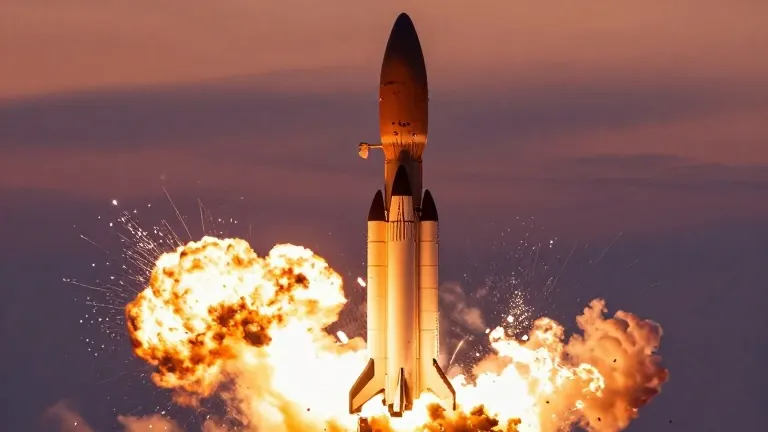
Starship reaches orbit after booster explodes in Gulf of Mexico
SpaceX's upper stage is scheduled to attempt a first-of-its-kind catch by launch tower arms on Saturday, following the loss of the first stage.
By Mei Wong ·
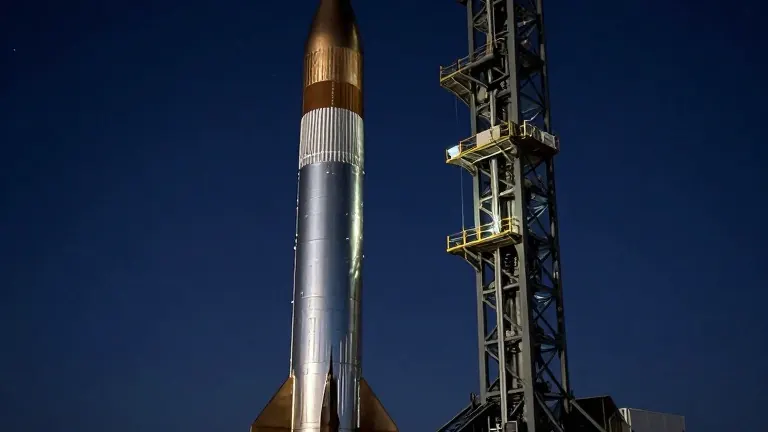
SpaceX’s Starship spacecraft entered orbit on Friday after the first-stage booster failed to return to its launch site and instead exploded in the Gulf of Mexico. The vehicle continued its flight plan despite the loss, and it is currently scheduled to steer back toward the pad in Texas for a midair capture on Saturday.
The flight marks the first time the company has attempted to retrieve the upper stage from space. Mechanical arms attached to the launch tower are positioned to catch the 171-foot spacecraft as it re-enters the atmosphere. The total duration of the flight could reach 22 hours, depending on orbital conditions.
Prior to this launch, SpaceX had successfully caught the booster three times at its Starbase facility near the U.S.-Mexico border. The company’s goal is to recover both stages for reuse, a process that has not yet been completed for any rocket in the world. Elon Musk has stated that full reusability is necessary to achieve the high launch rates required for lunar and Mars missions.
Shortly after reaching orbit, the spacecraft deployed 26 Starlink satellites. It will complete approximately 15 orbits at an altitude of about 170 miles before initiating its final descent. The booster, which stands 236 feet tall, is the production model intended for future deep-space travel. When combined with the upper stage, the full rocket reaches a height of 407 feet.
Launch commentator Kate Tice noted on air that the outcome was not the result the team had hoped for. She described the event as consistent with the rigorous safety checks designed to protect the launch pad. SpaceX did not provide a specific explanation for the booster failure during the post-launch briefing.
This test is part of a larger program to replace the company’s Falcon 9 rockets with fully reusable Starships. Kiko Dontchev, SpaceX’s vice president of launch, stated last week at a NASA summit that scaled-up infrastructure is the path to increasing launch frequency from ten to 100,000 per year. The company plans to begin launching Starships from Florida within a few months and from Louisiana in a few years.
NASA is currently using Starship to prepare for the Artemis lunar program. Administrator Jared Isaacman confirmed via social media that the agency is looking forward to testing on-orbit Starlink capabilities during the Artemis III mission next summer. NASA expects to select between SpaceX and Blue Origin for the crewed lunar landing no later than a year before the Artemis IV mission, which is targeted for as early as 2028.