Wakhan Corridor: New gravel road ends at sealed Chinese border
Afghanistan opened a 350-kilometer route through its easternmost province on October 4, but the high-altitude pass remains closed to commercial traffic without a set date for reopening.
By Charlotte Morgan ·
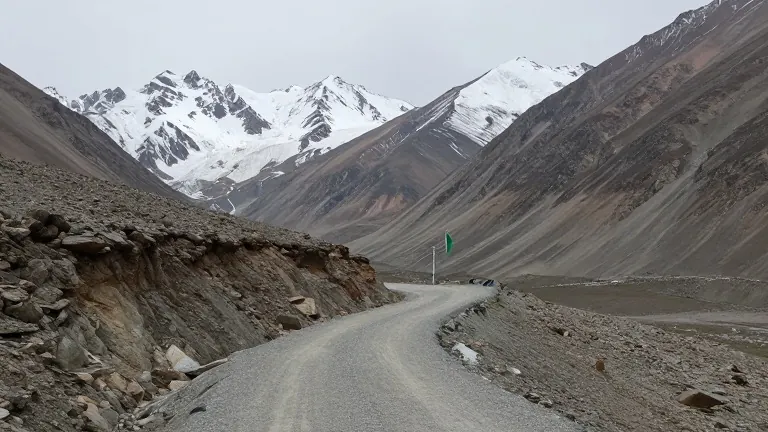
The Wakhjir Pass sits at nearly 4,900 meters, a high-altitude ridge where the territory of Afghanistan meets China. Snow typically locks this route away for five months each year, limiting crossings to brief windows in the warmer seasons.
On October 4, the Taliban-led government declared the completion of a new road leading to this frontier. The project, built by the Ministry of Rural Rehabilitation and Development, runs through the Wakhan Corridor in Badakhshan province. Officials announced the milestone during a ceremony, though the route stops just short of the actual border crossing point.
The road was constructed in two phases and cost 365 million afghanis, approximately $5.5 million. It remains an unpaved track surfaced with gravel. On the Chinese side, there is currently no customs facility. China’s Ministry of Foreign Affairs has not issued a public comment on the opening. No timeline exists for when Beijing might allow commercial vehicles to cross.
The Wakhan Corridor is a narrow, 350-kilometer strip of land that separates Tajikistan to the north from Pakistan to the south. Its shape was defined in 1895 by an agreement between Britain and Russia, designed to keep their empires from touching. China finalized its border with Afghanistan in 1963. In recent years, the area has become a point where the interests of China, Afghanistan, Pakistan, Iran, and Central Asian nations overlap.
Planning for this road began in 2009, but difficult terrain and security issues delayed work. Construction started in 2019 and covered 60 kilometers before the Taliban takeover in August 2021 paused progress. Javid Qaem, a former Afghan ambassador to China, said the Taliban resumed work in September 2023. By January 2024, the road reached the border. A contract for a second 71-kilometer phase, funded by the Afghan government, was signed in March 2025.
Beijing treats the corridor as a security priority rather than an economic opportunity. In August 2025, Chinese Foreign Minister Wang Yi visited Kabul and urged Afghan authorities to keep border patrols active and target Uighur separatist groups. An anonymous Afghan government source said China ties the opening of the border to strong security guarantees, especially for its western frontier and the Xinjiang region.
For Kabul, the road offers a way to diversify trade routes and rely less on neighbors Pakistan and Iran. Mohammad Ismail Ghaznawi, the deputy minister for road maintenance, described the project as a gateway to Chinese and Central Asian markets. He called the corridor a strategic link between South and Central Asia that could eventually connect Afghanistan to China’s Belt and Road Initiative.
Badakhshan province has faced recent security tensions, including attacks claimed by the National Resistance Front. Shah Mahmoud Miakhel, former acting defence minister, suggested that regional and international actors might be trying to block the project. Afghanistan shares borders with 14 countries, but only Bhutan and Afghanistan lack a direct overland trade crossing with their neighbors.