North Carolina Democrats Flip 3rd District After Redistricting Backfires
A 2025 map change aimed to strengthen Republican control in eastern North Carolina, but a wave election sent the new district to a Democrat.
By Charlotte Morgan ·
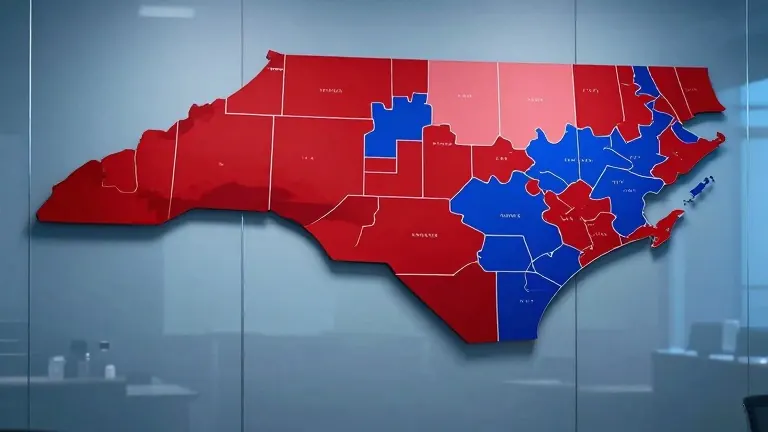
A redistricting plan intended to secure two Republican seats in North Carolina ended with both districts controlled by Democrats.
In October 2025, state legislative Republicans redrew the 1st and 3rd Congressional Districts in northeastern North Carolina. Senator Ralph Hise told the Senate Elections Committee that the new map was designed to help the party elect 11 Republicans. The actual election results produced 11 Democratic winners. In the 3rd District, Democratic challenger Raymond Smith defeated incumbent Republican Greg Murphy by a margin of 293 votes after provisional ballots were counted. Murphy conceded the race on Wednesday morning.
The map change shifted six counties from the 3rd District to the 1st District, while moving four counties and one precinct in the opposite direction. This move was intended to increase the Republican voting share in both areas. Hise noted that the change raised the projected Trump vote in the 1st District from 51% to 55% and lowered it in the 3rd District from 60% to 56%. However, the strategy failed in a national environment where President Trump’s approval rating hovered near 35%.
Political scientists label this outcome a dummymander, a term describing when a party’s redistricting effort accidentally benefits its opponents. Chris Cooper, director of the Haire Institute for Public Policy at Western Carolina University, called the North Carolina case a textbook example. He stated that the Republicans explicitly aimed to defeat Democrat Don Davis in the 1st District and hold the 3rd, but they failed in both. The 1st District incumbent, Don Davis, retained his seat, while Smith took the 3rd.
The national political climate played a major role in the outcome. Doug Heye, a former Republican National Committee spokesman, pointed to an Elon University poll that showed Trump’s approval at 34% and disapproval at 57% before the election. Heye said that if Trump’s approval had been higher, Republican incumbents likely would have won. Instead, low approval ratings made Republican incumbents vulnerable across the state.
The 3rd District race received limited national financial support compared to other contests. Republican-aligned groups spent $1.46 million on ads, while Democratic-aligned groups spent about $285,000. Anderson Clayton, chairwoman of the North Carolina Democratic Party, said her party relied on grassroots organizing to compete. Smith, a former state representative, used local connections to build support. Clayton observed during a campaign event that Smith’s experience and local knowledge positioned him to win the seat.
The Wikipedia page for dummymandering was updated to feature the North Carolina map as its primary example following Smith’s victory. Democratic Representative Deborah Ross posted on social media that the state had become the encyclopedia definition of the term. Cooper cautioned that the 2026 results might reverse in 2028, when Republicans will aim to reclaim the seats they lost. He noted that what appears as a dummymander now could look like a strategic gerrymander in two years.